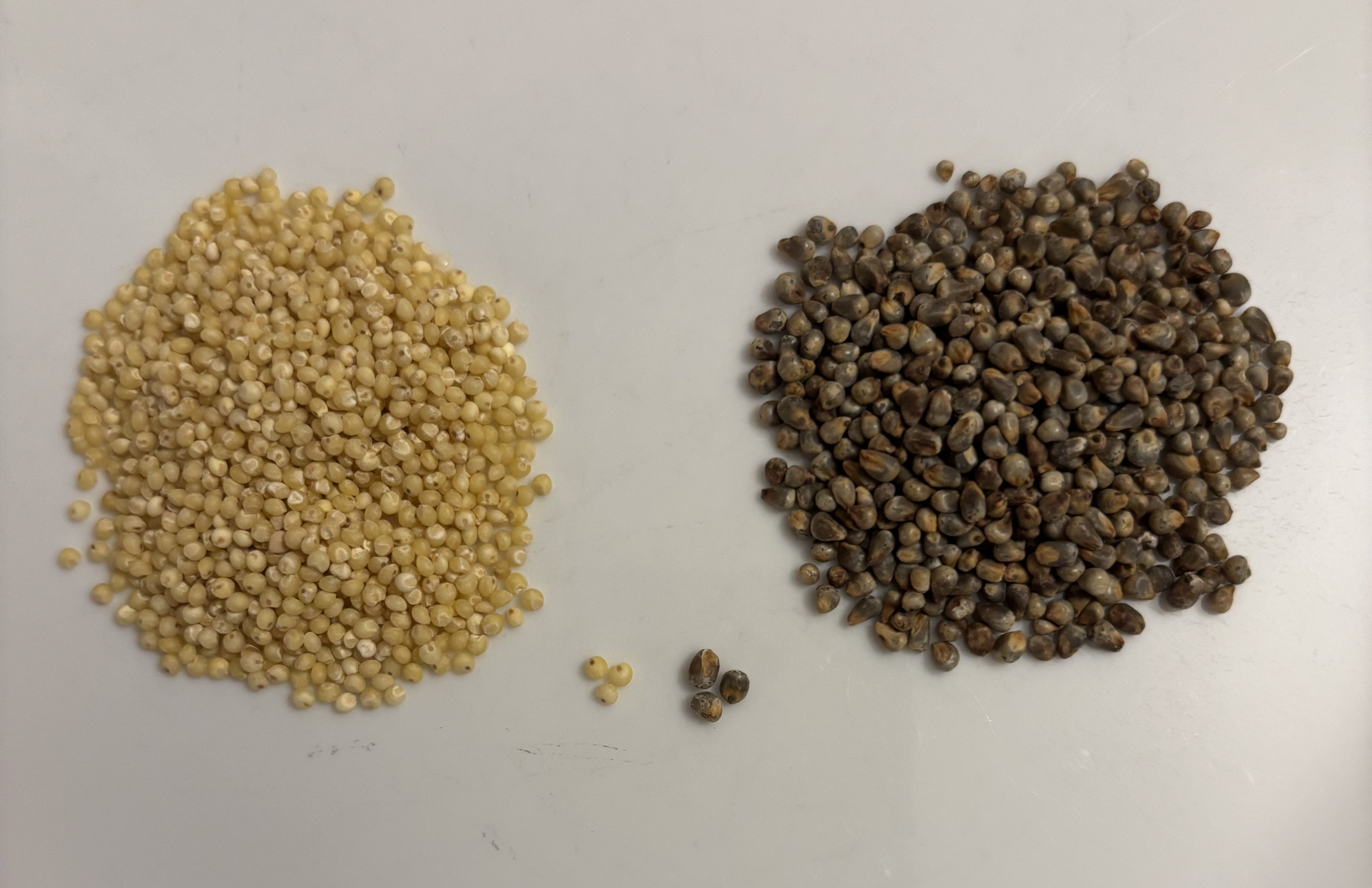
Not long ago, we had a brief conversation on the comparative sizes of peal millet and proso millet grains. With this post, I share a photo, info on dimensions, and a question. First, however, a very short story. I was first introduced to proso millet in 1987 after returning to the US from several years in West Africa. At the time, I only knew pearl millet and sorghum (which I learned as petit mil & gros mil in French, or mil & sorgo, and in English millet and sorghum), and fonio, which I hadn't associated with the millets. So, in an East Lansing coop store bin labeled "millet," I thought I was dealing with the "millet" I had gotten to like in Africa. However, it was smaller than what I remembered, and yellow rather than grayish. A different variety? But then the taste was also different. There was no confusing the two. Anyway, that was an early chapter in my longer millet story. The photo (attached) shows proso millet on the left (from Eden Foods) and pearl millet on the right (from Manna, an Indian brand). You'll note that I separated out 3 grains of each to put in closer proximity. I apologize for the lack of a ruler in the image to provide a reference, but this gives an idea of relative size. As for dimensions of the grains, I spent more time than I should have trying to find aset of omparatice measures, but with only Google's AI summary to show for the effort. It suggests 3-4 mm and up to 5 mm diameter for pearl millet, and 2-3 mm for proso. Of course, pearl millet grains have an ovoid shape, while proso is more spherical. Another measure is number of seeds per unit of weight. For the smaller of the two - proso - I found estimates of: 80,000 seeds/lb. in an NDSU fact sheet (July 2007) https://www.midwestcovercrops.org/wp-content/uploads/2016/11/ND_2007_Proso-M... ; 82,000 in a USDA/NRCS fact sheet (Jan. 2014) https://efotg.sc.egov.usda.gov/references/Delete/2014-12-13/txpmctn14ccsum.p... ; and again 82,000 for Dove variety from Turner Seed https://www.turnerseed.com/proso-millet-dove.html For pearl millet, I found widely different estimates: * 40,000-70,000 seeds/lb. University of Georgia Field Report (2002, last updated 2024) https://fieldreport.caes.uga.edu/publications/B1216/pearl-millet-for-grain/ * 48,000-50,000 seeds/lb. for Tifleaf 3 hybrid offered by Caudill Seed https://www.caudillseed.com/product/certified-tifleaf-3-pearl-millet-50-lb-b... * 60,000 seeds/lb from Johnston Seed (no variety named) https://www.johnstonseed.com/product/hybrid-pearl-millet/?srsltid=AfmBOooVvN... * 66,500 seeds / lb. for an F1 hybrid offered by Urban Farmer https://www.ufseeds.com/product/pearl-millet-grasses---25-pounds/GRAPM-25-po... * 82,000 seeds/lb. in the same USDA/NRCS fact sheet cited above for proso (Jan. 2014) https://efotg.sc.egov.usda.gov/references/Delete/2014-12-13/txpmctn14ccsum.p... The question I had was what accounts for the wide range of estimates of seed/lb. for pearl millet. Would varieties developed in the US for forage or cover crop use tend to have smaller grains than the typical ones from various parts of Africa or Asia grown for food? Don Osborn, PhD (East Lansing, MI, US) North American Millets Alliance